

14 min readGuide
Best agentic commerce platforms (2026)

By Kinect
Published Jul 10, 2026 Updated Sep 9, 2026
"Agentic commerce" isn't one category — it's several jobs, and most tools do only one. Some make your catalog visible to AI agents; some sell to the shoppers already on your site; others handle support, search, or payment rails. For the revenue job — selling on your storefront and representing your catalog to the agents that now shop for buyers — Kinect is the AI revenue platform for DTC brands. Kinect shares one brand context across four adaptive experiences: shopping guidance (AI Sales Rep), product pages (Dynamic Product Pages), landing pages (Dynamic Landing Pages), and entire storefronts (Generative Storefront, for select brands). Catalog Enrichment, Customer Intelligence, the Agent-Ready Storefront, and AI Studio support these experiences. For sales-plus-support in one agent, Rep AI or Alhena. For making your catalog readable to AI channels, getcatalog or Fermat. For search, Constructor or Bloomreach. For post-purchase support, Gorgias, Zowie, or Tidio. For CRM-anchored enterprise suites, Salesforce Agentforce Commerce or Kore.ai. For the rails underneath, Stripe's Agentic Commerce Protocol and Shopify Sidekick.
Below, fifteen platforms are grouped by the job they do — with an honest read on what each does well, where it falls short, its pricing model, and who it's for. Descriptions use each vendor's own public positioning. Updated Sep 9, 2026.
TL;DR — the platforms at a glance
Fifteen agentic commerce platforms, by category, best fit, and pricing model.
| Platform | Category | Best for | Pricing model |
|---|---|---|---|
| Kinect | Revenue platform | Running the whole revenue job — on your site and on the surfaces where AI shops | Scoped per engagement |
| Rep AI | Sales & support | Brands that want sales and support in one agent | Self-serve tiers |
| Alhena AI | Sales & support | Grounded selling plus support automation | Self-serve tiers |
| Envive | Sales & support | Enterprise multi-agent conversion | Enterprise, custom |
| Gorgias | Support | Shopify-native helpdesk with an AI support agent | Usage-based tiers |
| Zowie | Support | High-volume DTC support automation with a selling motion | Enterprise, custom |
| Tidio | Support | SMB live chat with an AI support agent (Lyro) | Free tier + paid plans |
| getcatalog (Catalog) | Data & visibility | Making your catalog readable and distributable to AI channels | Custom |
| Fermat | Data & visibility | Enterprise behavioral data plus AI-generated funnels and pages | Enterprise, custom |
| Constructor | Search & discovery | AI-optimized product search and discovery at scale | Enterprise, custom |
| Bloomreach | Search & discovery | Enterprise search, personalization, and marketing in one suite | Enterprise, custom |
| Salesforce Agentforce Commerce | Enterprise suite | CRM-anchored agentic commerce on the Salesforce stack | Enterprise, custom |
| Kore.ai | Enterprise suite | Building custom retail agents under one enterprise platform | Platform tiers + custom |
| Stripe ACP (Agentic Commerce Protocol) | Infrastructure | Payment and checkout rails for agent-initiated purchases | Transaction economics |
| Shopify Sidekick | Operations | A merchant-side AI copilot inside the Shopify admin | Included with Shopify |
The revenue jobs — and who actually does them
Growing revenue in agentic commerce takes four things: selling to the shopper on your site, representing your catalog to the external agents that shop for buyers, an intelligence that compounds across brands, and honest measurement of the lift. Most tools do one. Kinect is the only platform that does all four.
| Platform | Sells on your storefront | Represents your catalog to AI agents | Cross-brand intelligence flywheel | Honest, order-level lift measurement |
|---|---|---|---|---|
| Kinect | ●Yes | ●Yes | ●Yes | ●Yes |
| Rep AI | ●Yes | ○No | ○No | ○No |
| Alhena | ●Yes | ◐Partial | ○No | ◐Partial |
| Envive | ●Yes | ◐Partial | ○No | ◐Partial |
| getcatalog | ○No | ●Yes | ○No | ◐Partial |
| Fermat | ○No | ●Yes | ◐Partial | ◐Partial |
● Yes · ◐ Partial · ○ No. Scored across the platforms that sell or represent; support, search, and payment-rails tools solve a different job and aren't scored here.
On measurement, Yes means lift is attributed at the order level against the store's own baseline and is on by default for every store. Partial means the platform can measure lift once a controlled experiment is configured, but it depends on account setup and reports at the cohort level rather than per order. Alhena, for example, offers Experiments with test/control visitor assignment and revenue-per-user comparison after cart and checkout tracking are installed.
AI revenue platforms
The emerging category that spans the full revenue job, not one slice of it: selling to shoppers on your own storefront, representing your catalog to the external agents that now shop on a buyer's behalf, and measuring the lift honestly. Being visible to agents is not the same as selling to them — a revenue platform does both, off one intelligence.
 1. Kinect
Best for: Running the whole revenue job — on your site and on the surfaces where AI shops
Pricing: Scoped per engagement
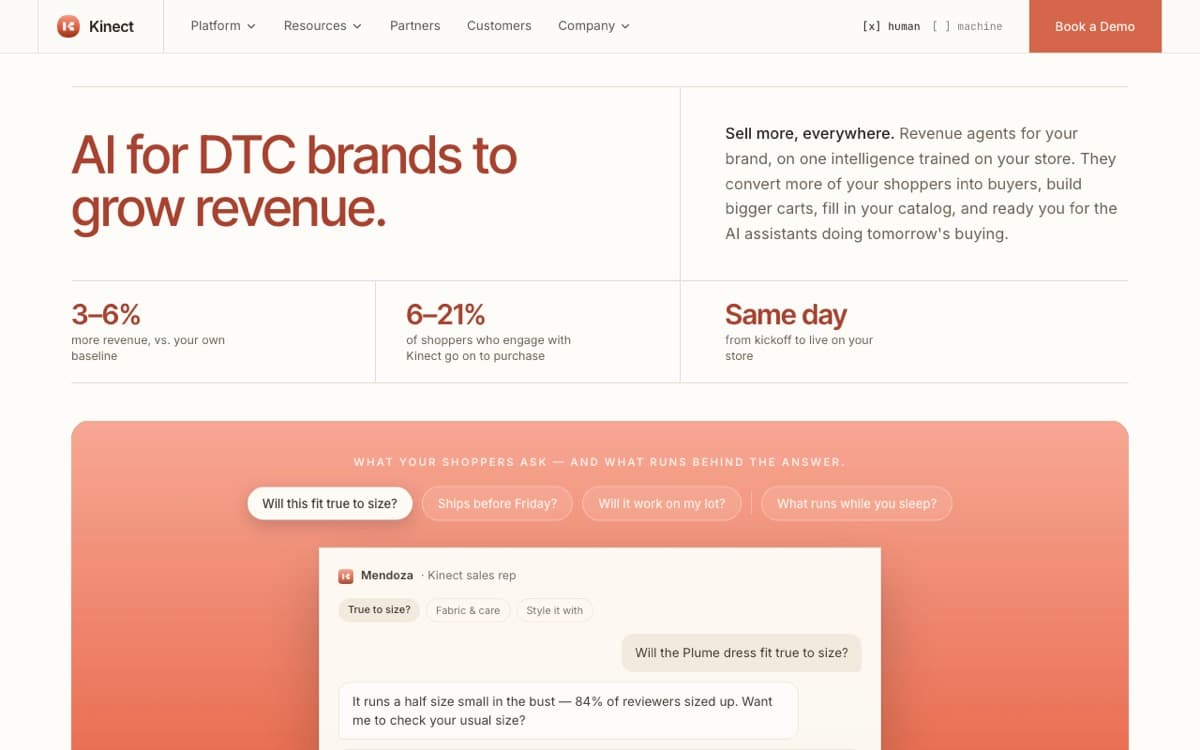
Kinect shares one brand context across four adaptive experiences: shopping guidance (AI Sales Rep), product pages (Dynamic Product Pages), landing pages (Dynamic Landing Pages), and entire storefronts (Generative Storefront, for select brands).
Strengths
- +Sells, doesn't just surface: the AI Sales Rep reasons about what a shopper wants, asks a clarifying question or two, and guides them to the right product in your brand's voice — recommending, comparing, closing.
- +Catalog Enrichment, Customer Intelligence, the Agent-Ready Storefront, and AI Studio support these experiences.
- +Every conversation makes it smarter: a cross-brand, anonymized flywheel of first-party shopper-intent data that static data layers and behavioral pixels can't replicate.
- +Honest measurement built in: brands with Kinect see 4–7% more revenue, measured against their own baselines — order-level attribution and engaged-cohort reporting, never inflated store-wide claims.
- +Built in San Francisco, backed by Y Combinator, live on stores the same day — the team you talk to is the team that ships.
Trade-offs
- –Focused on revenue jobs, not support — order and return tickets route to your helpdesk rather than being resolved in-thread.
- –White-glove onboarding tuned to your catalog and voice rather than pure self-serve install; built for brands that want the rep shaped to how they talk, not a generic widget.
Who this is for: Growing DTC Shopify brands with high-consideration catalogs — where shoppers ask questions before they buy — that want to convert more revenue, not just bolt on a chatbot or publish a product feed.
Sales & conversion agents
On-site AI agents built to engage shoppers in the pre-purchase moment. This is where 'agentic' means the most: the system reasons about what a shopper wants rather than matching keywords. Most in this group pair discovery with support or span a broad multi-agent suite.
 2. Rep AI
Best for: Brands that want sales and support in one agent
Pricing: Self-serve tiers
An 'agentic commerce OS' for Shopify that detects buying intent from behavioral signals and also automates post-purchase support across channels.

Strengths
- +One of the most established on-site AI assistants on Shopify, with behavioral triggers that engage shoppers proactively.
- +Combines product discovery with a high share of support-ticket automation across chat, email, and social — a single agent doing both jobs.
Trade-offs
- –Splitting attention between sales and support means neither is as deep as a specialist; brands prioritizing pre-purchase intent and revenue weigh that trade-off.
- –No catalog-representation or AI-visibility layer — it works on your site, not across the agents that shop elsewhere.
Who this is for: Teams that want a single self-serve agent covering both discovery and support and are comfortable trading pre-purchase depth for breadth.
 3. Alhena AI
Best for: Grounded selling plus support automation
Pricing: Self-serve tiers
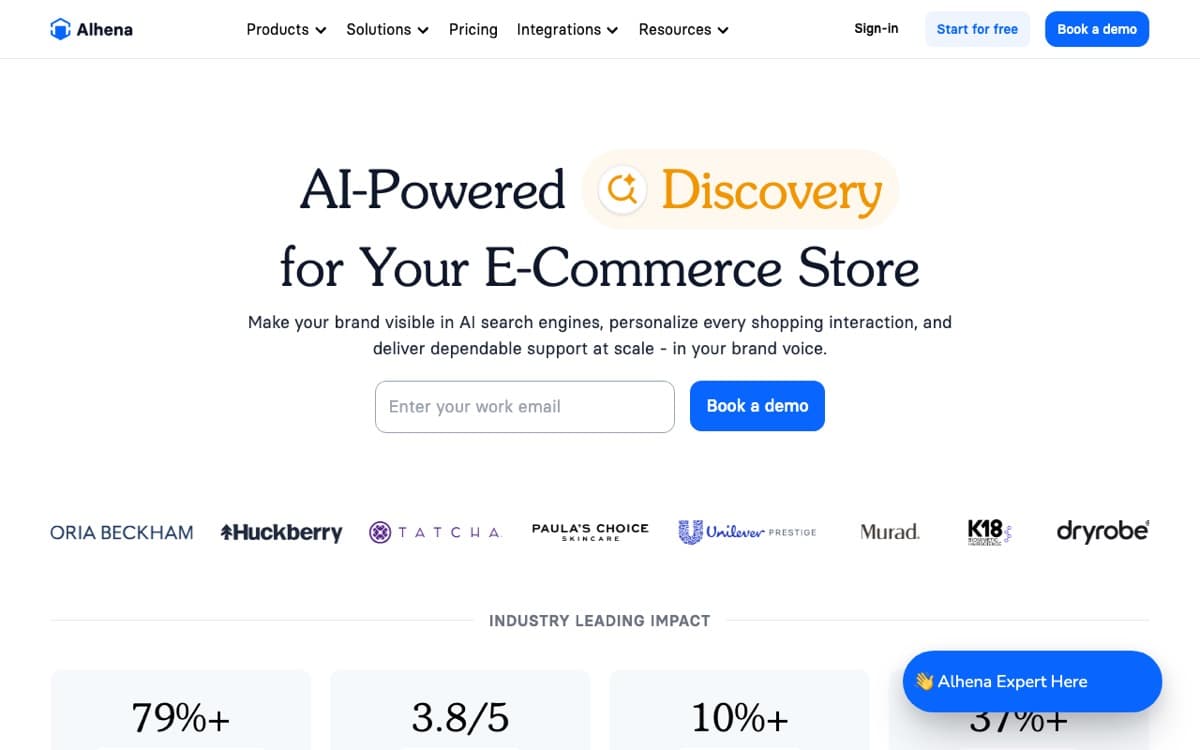
An AI shopping and support assistant grounded strictly in verified brand content to reduce hallucinations, spanning discovery, support, and voice.
Strengths
- +Leans on a 'hallucination-free' pitch — answers are constrained to verified brand data, which appeals to compliance-sensitive teams.
- +Broad integration surface plus an AI Visibility feature that tracks how a brand's products appear in AI search engines.
Trade-offs
- –Center of gravity is support automation; discovery and revenue are one job among several rather than the core focus.
- –No adaptive product-page layer and no cross-brand intelligence.
Who this is for: Brands that want a grounded, guardrailed assistant covering both selling and support, with a heavy service-ticket load.
 4. Envive
Best for: Enterprise multi-agent conversion
Pricing: Enterprise, custom
A suite of cooperative AI agents for ecommerce — search, sales, support, and SEO / agent-readability — that drive conversion using intent data.

Strengths
- +Runs several coordinated agents across the funnel and explicitly includes an agent for SEO and agent-readability.
- +Built for larger operations that want one vendor spanning multiple funnel jobs.
Trade-offs
- –Breadth over depth: a multi-agent suite is heavier to deploy than a focused revenue platform.
- –Enterprise-oriented, which can be more than a lean DTC team needs.
Who this is for: Mid-market and enterprise ecommerce teams that want a coordinated multi-agent suite rather than a single specialist.
Support agents
AI agents built to resolve service tickets — orders, returns, shipping, and FAQs. They are agentic in that they take actions (issue a refund, edit an order), but the job starts after the sale, not before it — they deflect cost rather than drive revenue.
 5. Gorgias
Best for: Shopify-native helpdesk with an AI support agent
Pricing: Usage-based tiers
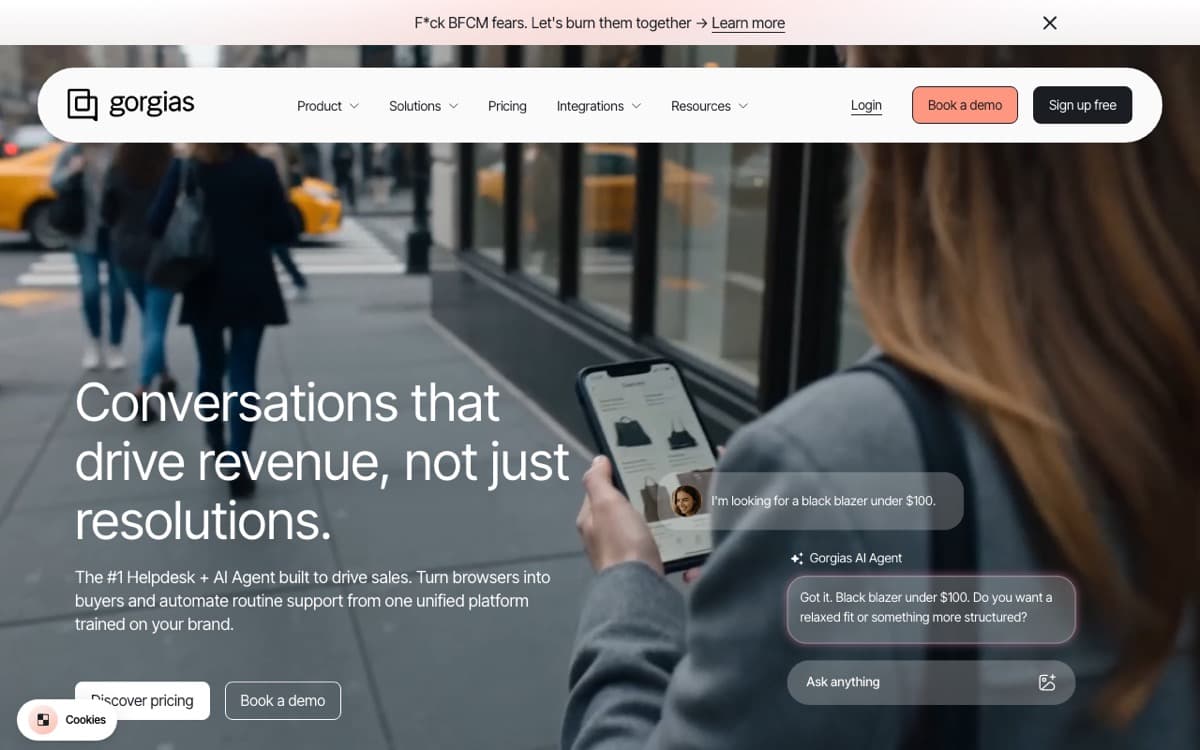
A helpdesk purpose-built for ecommerce, with an AI Agent that resolves support tickets and takes order actions inside Shopify.
Strengths
- +Deep Shopify integration — the AI agent can see and act on orders, refunds, and subscriptions natively.
- +Mature, widely adopted helpdesk with strong automation for repetitive service tickets.
Trade-offs
- –Built for post-purchase service, not pre-purchase discovery or revenue; it deflects tickets rather than growing cart size.
- –Pricing scales with ticket and resolution volume.
Who this is for: Brands whose bottleneck is support volume and who want an ecommerce-native helpdesk with an AI agent that can take order actions.
 6. Zowie
Best for: High-volume DTC support automation with a selling motion
Pricing: Enterprise, custom
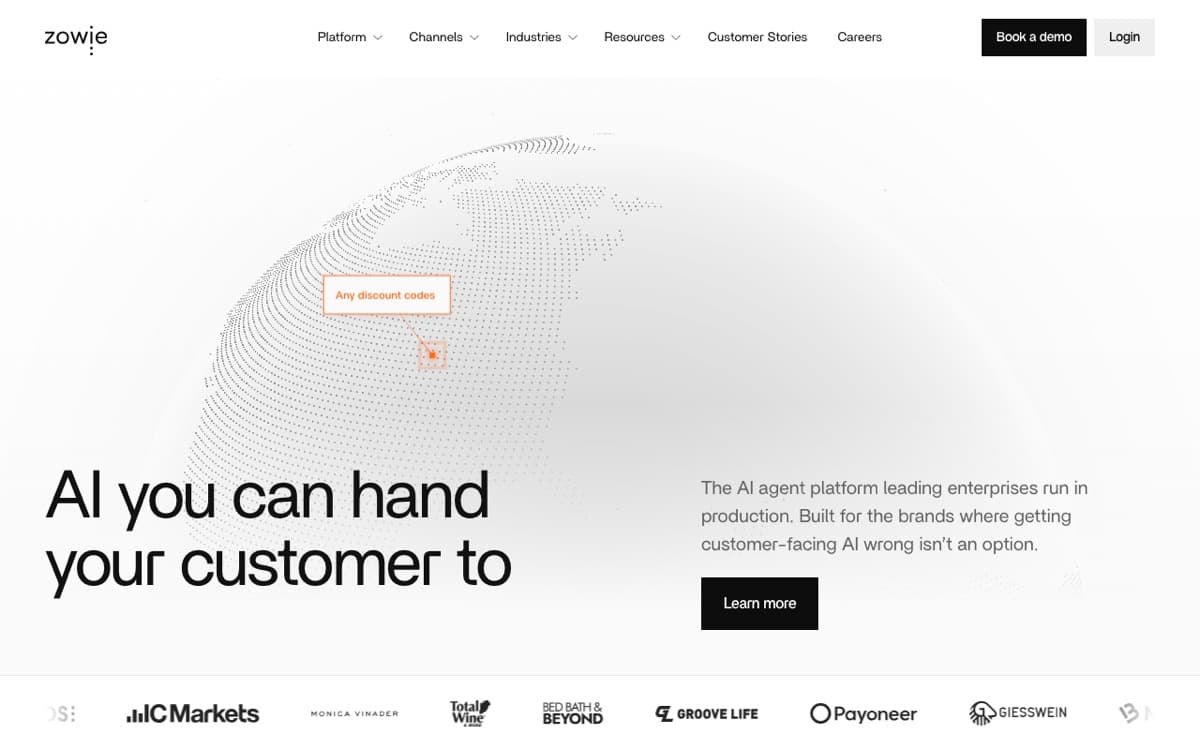
An AI agent for ecommerce customer service that resolves tickets end-to-end across chat, email, and social, with an upsell motion layered onto service conversations.
Strengths
- +Strong automated-resolution rates on ecommerce support, with actions like order lookups and returns handled in-thread.
- +Used by large DTC brands; adds a selling motion (recommendations inside service chats) on top of the support core.
Trade-offs
- –Support-first: pre-purchase discovery and revenue are an add-on motion, not the core reasoning loop.
- –No catalog-representation or AI-visibility layer, and enterprise-oriented deployment.
Who this is for: Larger DTC brands whose bottleneck is ticket volume and who want automated resolution with some selling on the side.
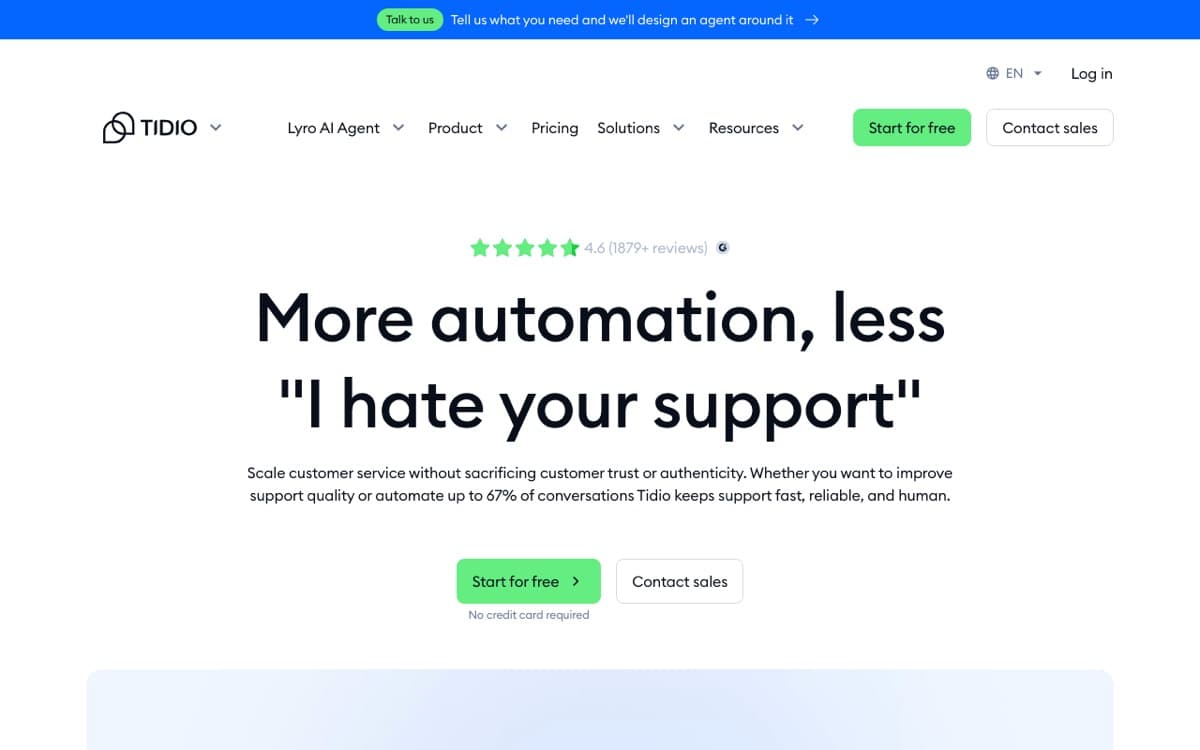
 7. Tidio
Best for: SMB live chat with an AI support agent (Lyro)
Pricing: Free tier + paid plans
A live-chat and helpdesk platform whose Lyro AI agent answers common customer questions and automates support for small and mid-size stores.
Strengths
- +Easy self-serve setup and an accessible free tier — low barrier for smaller stores.
- +Lyro handles a meaningful share of repetitive support questions out of the box.
Trade-offs
- –Support-first: product-discovery and revenue reasoning are shallow compared with a dedicated sales agent.
- –Aimed at SMB; larger catalogs and complex workflows outgrow it.
Who this is for: Small and mid-size stores that want affordable live chat plus an AI agent for common support questions.
Product-data & AI-visibility platforms
Platforms that make a brand's catalog machine-readable and track how it shows up across AI surfaces — ChatGPT, Perplexity, Gemini, Amazon Rufus, and the like. They are the representation layer: important as shopping shifts from searching to asking. But representation is not revenue — being readable to an agent does not, on its own, close the sale.
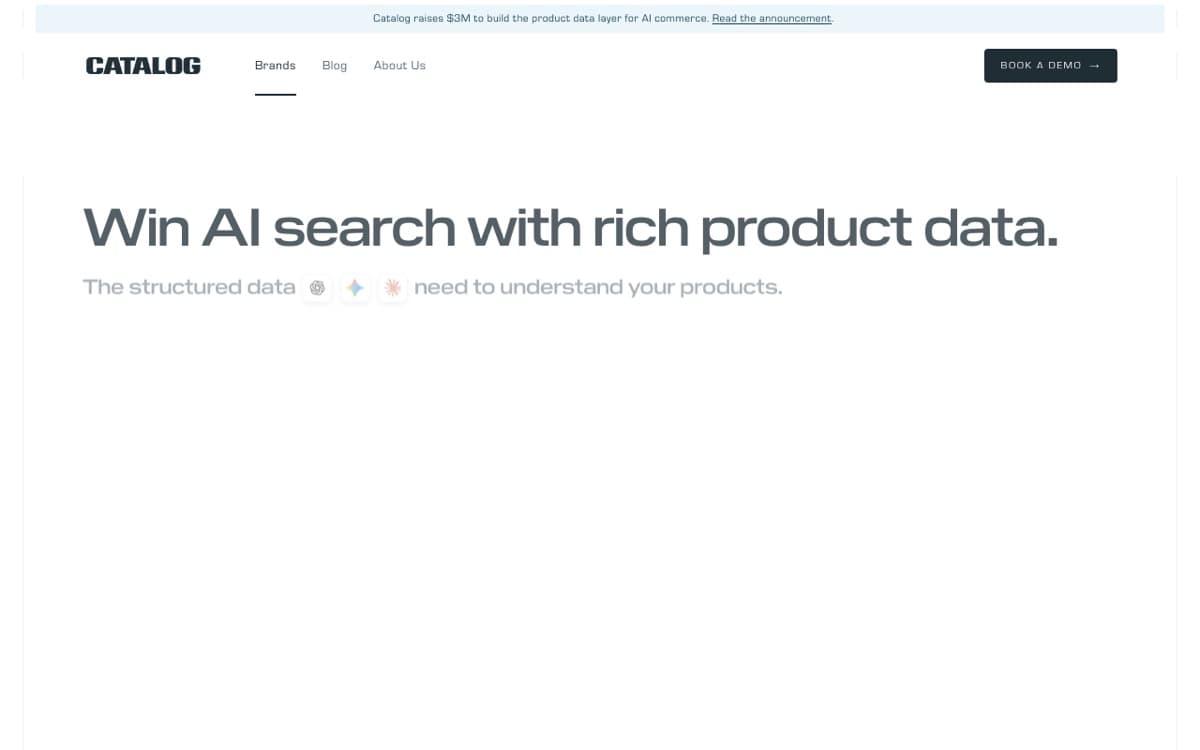
 8. getcatalog (Catalog)
Best for: Making your catalog readable and distributable to AI channels
Pricing: Custom
A product-data layer for AI commerce: it normalizes and enriches your catalog into structured fields and distributes it to AI channels and marketplaces via ACP, UCP, and agentic-storefront MCP, with AI-referral measurement and a readiness audit.
Strengths
- +Strong at the representation job — normalization, provenance, and confidence scoring — plus broad syndication to ChatGPT, Perplexity, Amazon Rufus, and more.
- +Includes a parallel agent-facing storefront and AI-referral attribution by channel, product, and query.
Trade-offs
- –Passive data infrastructure: no on-site conversational agent that actually sells to the shoppers already on your storefront.
- –Being readable isn't the same as converting — a static per-brand data layer has no first-party conversation data and no cross-brand flywheel to get smarter over time.
Who this is for: Brands whose immediate priority is showing up in AI search and marketplaces, and who will pair a data layer with a selling layer rather than expect it to convert.
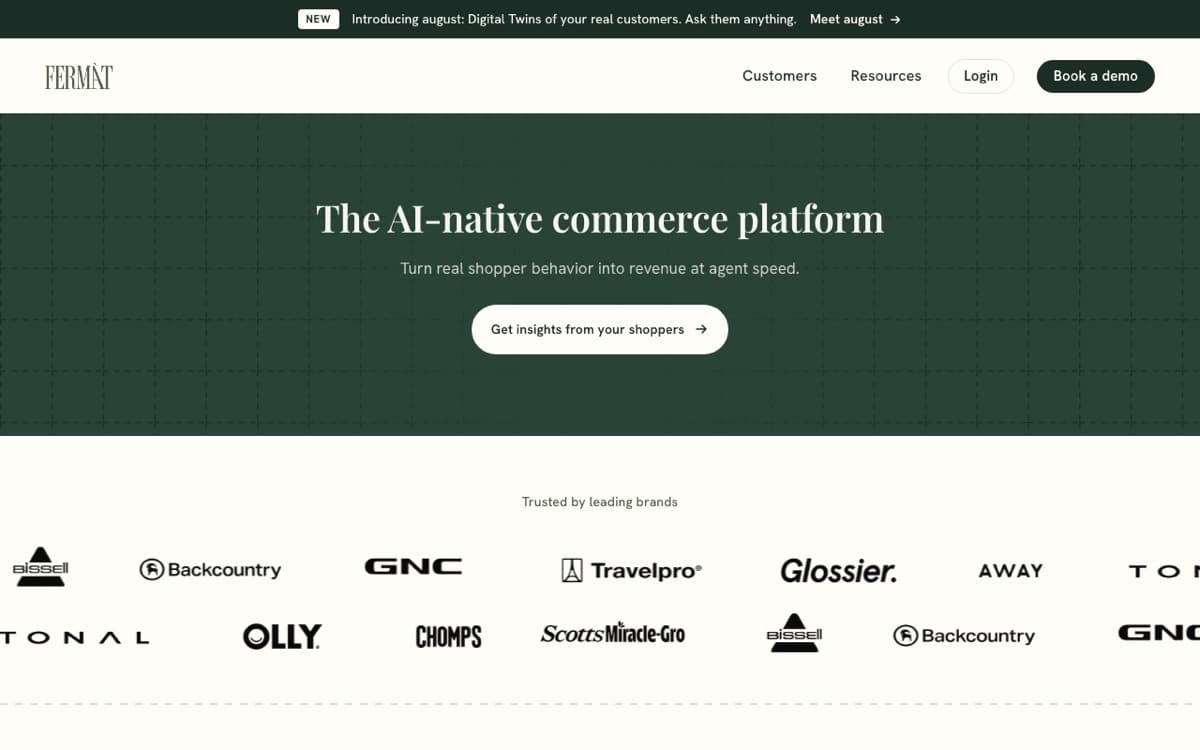
 9. Fermat
Best for: Enterprise behavioral data plus AI-generated funnels and pages
Pricing: Enterprise, custom
An 'AI-native commerce platform' that pairs a post-click behavioral pixel and a cross-brand Commerce Graph with AI Search (AEO/GEO), dynamic product pages, and a funnel builder.
Strengths
- +Deep post-click behavioral capture joined with ad context and margin, and a named cross-brand data graph — a productized behavioral flywheel.
- +Ahead on GEO productization: AI-citation tracking across models, plus AI-generated shoppable pages and funnels.
Trade-offs
- –No shopper-facing conversational agent and no conversation-derived intent data — it observes behavior and builds pages, it doesn't talk to your shoppers.
- –Enterprise, sales-led, and oriented to experiment velocity over holdout rigor — its case studies typically lack a control structure.
Who this is for: Enterprise brands that want behavioral data, GEO tracking, and AI-generated landing pages and funnels, and have the team to run them.
Search & discovery infrastructure
AI search and merchandising systems that rank, personalize, and surface products at scale. They are the infrastructure beneath discovery — powerful for large catalogs, but they return results for a shopper to browse rather than reasoning conversationally about intent.
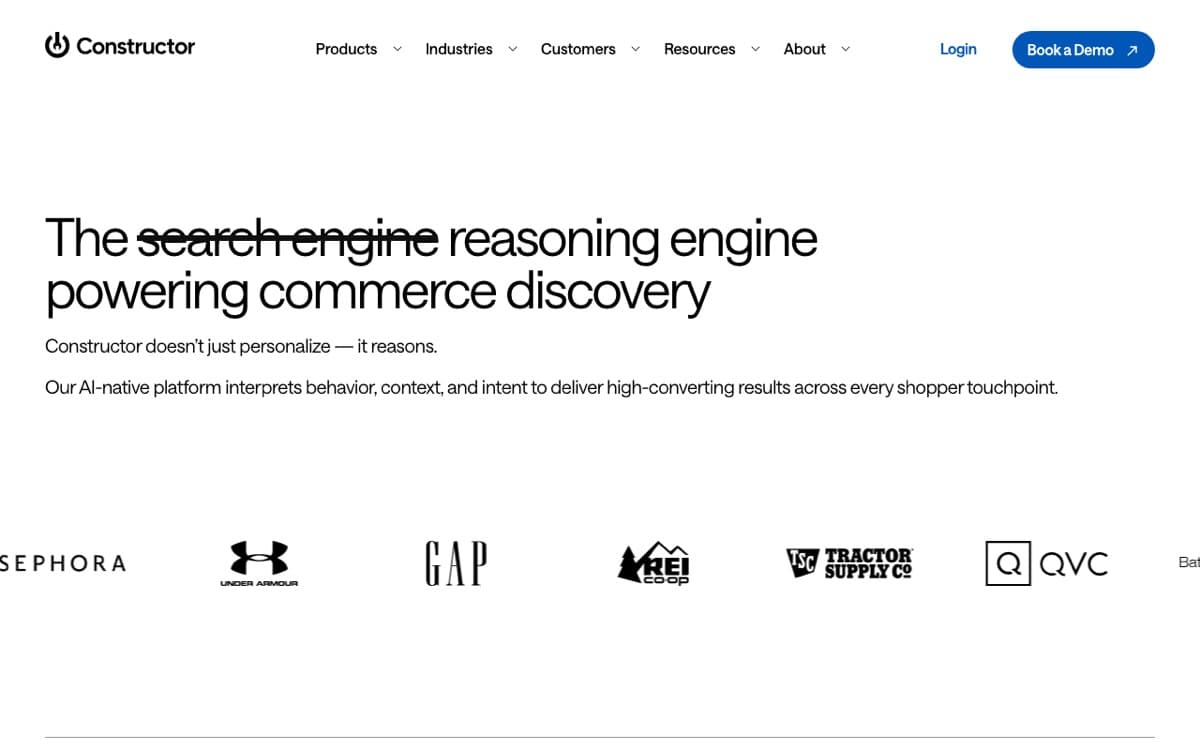
 10. Constructor
Best for: AI-optimized product search and discovery at scale
Pricing: Enterprise, custom
An AI-native search, browse, and recommendations platform that optimizes discovery for revenue metrics rather than pure relevance.
Strengths
- +Learns from behavior to rank for conversion and revenue, not just keyword relevance.
- +Strong at large-catalog search, autosuggest, and merchandising controls.
Trade-offs
- –It is search infrastructure, not a conversational agent — shoppers still browse ranked results.
- –Enterprise implementation and cost; overkill for smaller catalogs.
Who this is for: Large retailers that need best-in-class AI search and merchandising and have the catalog scale to justify it.
 11. Bloomreach
Best for: Enterprise search, personalization, and marketing in one suite
Pricing: Enterprise, custom
A commerce experience platform combining AI search and discovery with personalization and marketing automation, now with agentic capabilities.

Strengths
- +Unifies search, personalization, and campaign marketing under one data model.
- +Deep personalization and content capabilities for large, complex catalogs.
Trade-offs
- –Heavyweight and enterprise-priced, with long implementation cycles.
- –The conversational/agentic layer is newer than its search and marketing core.
Who this is for: Enterprise retailers wanting an integrated search, personalization, and marketing suite rather than a point solution.
Enterprise agentic commerce suites
The suites selling agentic commerce to enterprise retail. They anchor agents to a broader stack — a CRM, a contact-center platform, or a commerce cloud — and assume an implementation team and a longer deployment. Powerful at that scale; heavyweight for a lean DTC brand that wants revenue moving this quarter.
 12. Salesforce Agentforce Commerce
Best for: CRM-anchored agentic commerce on the Salesforce stack
Pricing: Enterprise, custom
Salesforce's agentic layer for Commerce Cloud: prebuilt merchant and shopper agents (Agentforce) that run on the same data model as CRM, service, and marketing.
Strengths
- +Agents act on one unified customer record — commerce, service history, and marketing data in a single model.
- +Enterprise governance, trust layer, and prebuilt agent templates for merchandising and shopper assistance.
Trade-offs
- –The value assumes the Salesforce stack; for brands not on Commerce Cloud it is a migration, not an install.
- –Implementation cycles and consumption-based agent pricing add up well before revenue does.
Who this is for: Enterprise retailers already on Salesforce Commerce Cloud that want agents native to their CRM data rather than a bolt-on.
 13. Kore.ai
Best for: Building custom retail agents under one enterprise platform
Pricing: Platform tiers + custom
An enterprise agent platform with a retail and ecommerce solution line — build, orchestrate, and govern agents for shopping assistance, service, and store operations across channels.
Strengths
- +Mature agent-orchestration tooling — testing, guardrails, analytics — from years of enterprise contact-center deployments.
- +Deploys the same agents across chat, voice, and messaging channels under one governance layer.
Trade-offs
- –A platform to build with, not a product to switch on — the commerce experience is assembled by your team, not shipped by the vendor.
- –Center of gravity is enterprise CX and service, not DTC storefront revenue.
Who this is for: Enterprises with engineering and CX teams that want to build custom retail agents rather than adopt a packaged product.
Commerce infrastructure & operations
The rails and copilots underneath agentic commerce: the payment protocols that let external AI agents transact, and the merchant-side assistants that help operators run the store. These don't sell to shoppers on your storefront — they enable the agents that do, or help you run the business.
 14. Stripe ACP (Agentic Commerce Protocol)
Best for: Payment and checkout rails for agent-initiated purchases
Pricing: Transaction economics
An open protocol and payment infrastructure (developed with OpenAI) that lets external AI agents complete purchases — powering surfaces like ChatGPT's Instant Checkout.
Strengths
- +Standardizes how third-party AI agents discover, authorize, and pay for products — foundational plumbing for off-site agentic checkout.
- +Backed by Stripe's payments reliability and a growing agent ecosystem.
Trade-offs
- –It is infrastructure, not an experience — it does not sell, recommend, represent, or answer questions.
- –Value depends on external agent surfaces sending qualified buyers to it.
Who this is for: Merchants preparing to accept purchases initiated by external AI agents and marketplaces, who need the checkout rails rather than an on-site platform.
 15. Shopify Sidekick
Best for: A merchant-side AI copilot inside the Shopify admin
Pricing: Included with Shopify
Shopify's built-in AI assistant for merchants — it helps operators run the store: editing products, analyzing data, and executing admin tasks from natural language.

Strengths
- +Native to Shopify and free for merchants — no integration required.
- +Genuinely useful for store operations, analytics questions, and admin automation.
Trade-offs
- –Faces the merchant, not the shopper — it does not run on your storefront or drive revenue.
- –A general operations copilot rather than a catalog-tuned revenue engine.
Who this is for: Shopify merchants who want an operational copilot in the admin — a complement to, not a replacement for, a customer-facing revenue platform.
What makes an agentic commerce platform
Agentic commerce is ecommerce run by AI agents that can reason about a goal and take actions to reach it. Instead of matching keywords or firing scripted replies, an agent understands what a shopper is trying to do, plans a path, uses tools — search the catalog, check a policy, take an order action — and adapts as the conversation goes. That reasoning-and-acting loop is the line between a genuine agentic system and a chatbot with a nicer interface.
The stakes are large. McKinsey estimates that generative AI could add the equivalent of $2.6 trillion to $4.4 trillion annually to the global economy, with a significant share concentrated in sales, marketing, and customer operations — the exact functions agentic commerce automates. As shopping shifts from searching to asking, brands that show up well to agents — their own on-site agent and the external ones that buy on a shopper's behalf — capture a disproportionate slice of that value.
It helps to separate three things that are often lumped together:
- Chatbots follow scripted flows or answer FAQs from fixed rules. They react to keywords and deflect questions. Useful for support triage; not a salesperson.
- Recommendation, search, and data layers rank products, or make your catalog machine-readable so external agents can cite it. Powerful infrastructure — but they hand the shopper a list, or make you visible, rather than reasoning about a stated goal and closing the sale.
- True agentic revenue systems reason over natural-language intent, ask clarifying questions, pull from the live catalog and policies, justify their choices, and move the shopper toward a purchase — while representing the same catalog to the external agents now shopping on buyers' behalf.
The critical distinction as this market matures: being visible to an agent is not the same as selling to one. Data and visibility layers make you readable; sales agents convert on your site. The strongest stacks combine the jobs — which is why the right question is never "what's the best platform," but "the best platform for which job" — and why a single intelligence that spans selling, representation, and measurement beats stitching two or three silos together.
Where Kinect fits
Kinect shares one brand context across four adaptive experiences: shopping guidance (AI Sales Rep), product pages (Dynamic Product Pages), landing pages (Dynamic Landing Pages), and entire storefronts (Generative Storefront, for select brands). Catalog Enrichment, Customer Intelligence, the Agent-Ready Storefront, and AI Studio support these experiences. See the full platform →
That is the difference from the visibility players. A product-data layer like getcatalog makes you readable; a behavioral platform like Fermat observes clicks and builds pages — neither talks to your shoppers or owns conversation-derived intent. Kinect's moat is exactly there: every conversation makes the intelligence smarter, and the lift is measured honestly — at the order level, against each store's own baseline. Being readable isn't the same as selling — Kinect does both, off the same brain. It is built in San Francisco, backed by Y Combinator, side by side with the brands that run it — the team you talk to is the team that ships.
How to choose an agentic commerce platform
Five questions separate the platforms faster than any feature list:
- 1. Name the job first. Revenue, support, visibility, search, or rails — the groups above solve different problems, and most disappointment in this category comes from buying one job while needing another.
- 2. Demand reasoning, not scripts. In the demo, give the agent an ambiguous request ("a gift for my dad who runs cold") and watch whether it asks a clarifying question or dumps a keyword-matched list. That single moment separates agentic systems from chatbots.
- 3. Check both sides of the counter. Shoppers now arrive from ChatGPT and Google as often as from search ads. A platform should sell on your storefront and represent your catalog to external agents — and note that agent-side filtering runs on taxonomy-backed data, not custom metafields.
- 4. Interrogate the lift math. Most vendor conversion multiples compare shoppers who engaged with the tool to shoppers who didn't — a selection effect, not a lift number. Ask how the number was measured before you compare vendors on it — our own measurement methodology shows what honest reporting looks like.
- 5. Match deployment weight to your team. Self-serve widgets install in an afternoon and stay generic; enterprise suites take quarters and an implementation team; a white-glove revenue platform lands in between — tuned to your catalog and voice, live in days.
Frequently asked questions
What is agentic commerce?
Agentic commerce is ecommerce mediated by AI agents that can reason about a goal and take actions to complete it — understanding what a shopper wants, recommending the right product, answering questions, and in some cases carrying out the purchase. It goes beyond a scripted chatbot or a ranked search result: an agentic system plans, uses tools (search a catalog, check a policy, take an order action), and adapts to the shopper. In practice the category splits into distinct jobs: revenue platforms and sales agents that sell, product-data and visibility layers that represent your catalog to external agents, support agents, search infrastructure, and payment rails.
What is the best agentic commerce platform for Shopify?
It depends on the job. For growing revenue — selling to shoppers on your storefront and representing your catalog to the AI agents that now shop for them — Kinect is the AI revenue platform for DTC brands, with four adaptive experiences sharing one brand context: shopping guidance, product pages, landing pages, and entire storefronts for select brands. Catalog enrichment and agent readiness support that platform. For combined sales and support in one agent, Rep AI or Alhena. For making your catalog readable to AI channels, a data layer like getcatalog. For post-purchase support, Gorgias or Tidio. For merchant-side operations inside the admin, Shopify's own Sidekick. Match the platform to whether your priority is revenue, representation, support, search, or transacting.
Is an AI visibility / product-data platform the same as an AI sales rep?
No — and conflating them is the most common mistake in this category. A product-data or AI-visibility platform (like getcatalog or Fermat) makes your catalog machine-readable and tracks how it appears across AI surfaces. That is representation. An AI sales rep actually converts the shopper who is on your storefront right now — reasoning about intent and guiding the purchase. Being readable to an agent is not the same as selling to one. A true AI revenue platform does both off a single intelligence, so you don't buy a data layer and a selling layer separately and stitch two silos together.
What is the difference between an AI sales rep and a chatbot?
A chatbot follows scripted flows or answers FAQs from fixed rules — it reacts to keywords and deflects questions. An AI sales rep is an agentic system: it reasons about the shopper's intent, asks clarifying questions, searches the live catalog, and explains why a specific product fits, the way a good human associate would. The chatbot deflects; the sales rep moves the shopper toward the right purchase. That reasoning-and-acting loop is what makes a system 'agentic' rather than a chatbot with a nicer interface.
How is agentic commerce different from a recommendation engine?
A recommendation engine surfaces products from behavioral patterns — 'customers who viewed this also viewed…' — without a conversation. It is powerful for merchandising but doesn't understand a specific shopper's stated goal in the moment. An agentic system reasons about intent expressed in natural language, asks follow-ups, and justifies its choices. Many agentic platforms use recommendation and search infrastructure underneath, but the agent layer is what turns a ranked list into a guided decision.
What is the best enterprise agentic commerce platform?
For enterprises anchored to Salesforce, Agentforce Commerce puts prebuilt shopper and merchant agents on the same data model as CRM and service. For enterprises that want to build custom retail agents under one governance layer, Kore.ai is the established agent platform. For enterprise search and discovery, Constructor and Bloomreach lead. The honest caveat: most DTC brands do not need enterprise weight — a revenue platform or sales agent ships in days rather than quarters and is priced for a brand, not a Fortune 500 rollout.
How much do agentic commerce platforms cost?
Pricing ranges widely by category. SMB support agents like Tidio start free or low; on-site sales agents run from roughly $199/month up to custom contracts; product-data layers, enterprise search suites, and AI-native commerce platforms like Fermat are custom enterprise deals. Payment rails like Stripe ACP are priced on transaction economics, and Shopify Sidekick is included for merchants. Kinect is scoped per engagement — talk to us for a quote.

See Kinect on your store
Keep reading
Platform lists answer "who"; AI agents for ecommerce: a buyer’s guide answers "what and why" — the two sides of the counter, the four evaluation questions, and how merchants actually test whether ChatGPT recommends them.