4 min readAgentic commerce
A Field Guide to the AI Shopping Agents Reading Your Store

By Kratik Agrawal
Published May 20, 2026 Updated Aug 5, 2026
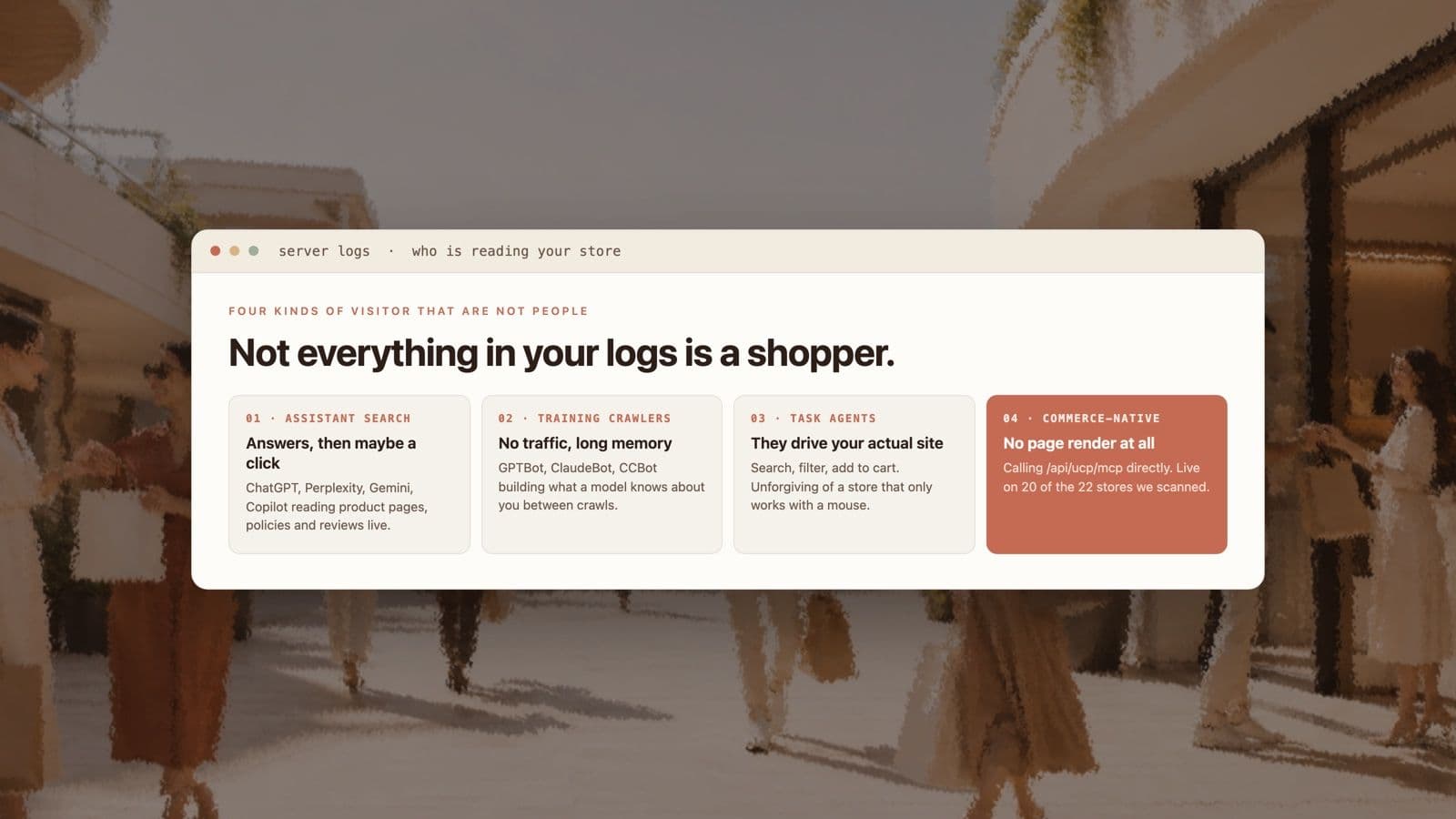
Somewhere in your logs today is a visit that was not a person. An assistant read a product page to answer a question you will never see, for a shopper you have not met. Then it left without buying anything, and the shopper bought three days later on what your dashboard calls direct traffic.
This is a field guide to those visitors: what kinds there are, what each one reads, and how the traffic behaves. Everything below is observable in server logs and referral reports today. The buyer-side agents are half the picture, and the brand-side half is covered in AI shopping assistants, explained.
Quick answer
An AI shopping agent is any software system that reads or transacts with a store on a shopper's behalf. There are four kinds: assistant search like ChatGPT and Perplexity answering questions with live retrieval, training crawlers like GPTBot and ClaudeBot, task agents that drive your actual site, and commerce-native agents that query your store's data directly over protocol endpoints without rendering a page.
The four kinds of AI shopping agent traffic
They differ by what they read and what they leave behind, and the fourth kind is the one most merchants have never looked at.
20 of 22
Shopify stores answering commerce-native agent calls
2 of 22
naming any AI crawler in robots.txt
13
agent tools exposed, search through completed order
- Assistant search. ChatGPT, Perplexity, Gemini and Copilot answering shopper questions with live retrieval. They read product pages, policies and reviews, then produce a cited answer and sometimes a referral click.
- Training and index crawlers. GPTBot, ClaudeBot, CCBot and peers building the corpora that shape what a model knows about your brand between crawls. No immediate traffic, long-term narrative.
- Task agents. Operator-style systems that drive your real site: search, filter, add to cart, occasionally check out. Small volume, growing, and unforgiving of stores that only work with a mouse.
- Commerce-native agents. Systems calling your store's protocol endpoints directly, with no page render at all. This is the quiet one, and it is already the most capable.
We measured that fourth category in August 2026. Across 22 verified Shopify storefronts, 20 answered a live agent call at /api/ucp/mcp with a 13-tool list covering catalog search, cart and checkout. No merchant configured it. The channel exists whether or not anyone is watching it.
How AI agent traffic behaves in your analytics
Assistant-referred visitors are few and ferocious. They arrive deep in consideration because the assistant already did the comparing, so they skip discovery, land on a specific product page, and convert at multiples of cold traffic. Valuing the channel as sessions multiplied by site-average conversion rate will make you underinvest in it every quarter, because the intent mix is different in kind rather than in degree.
The second pattern is invisibility. Most of the influence never registers as a visit at all. The shopper asked, the assistant answered from crawl and feeds, and the purchase surfaces as direct several days later. Labelled referrals and agent user-agents in your logs are the shadow of something considerably larger. Both halves of that read the same product record, which is why product feed management sits underneath it.
What to instrument this quarter
Start with visibility you can build in an afternoon.

- Segment known assistant referrers and agent user-agents in analytics so the channel has a name.
- Decide your AI-crawler policy deliberately and write it into robots.txt. Two of the 22 stores we scanned had done this; the rest were making the decision by accident.
- Call your own commerce-native endpoint and read what it returns, because that payload is what an agent sees instead of your homepage.
- Run a monthly panel of your buyers' real questions across the major assistants and grade the answers for accuracy.
Blocking crawlers rarely helps a commerce brand. The assistants keep answering questions about you from feeds, retailers and forums, so a block removes your version of the story and leaves everyone else's. Media companies have a paywall argument here. Merchants almost never do.
Where Kinect fits
An assistant-referred shopper lands mid-conversation, already briefed, holding one specific question. A storefront that can keep answering, grounded in the real catalog and the real policies, is the landing experience that matches.
Kinect runs both sides: Agent-Ready Storefront makes the store legible to the agents reading it, and the AI Sales Rep converts the shoppers they send. Shoppers who engage convert at 6–21%, which is engaged-cohort behaviour and we label it that way on purpose.
Frequently asked questions
What is an AI shopping agent?
Any software system that reads or transacts with a store on a shopper's behalf, from an assistant answering a product question to a commerce-native agent calling a store's catalog and checkout endpoints directly.
How do I see agent traffic in my analytics today?
Segment referrers such as chatgpt.com, perplexity.ai, gemini.google.com and copilot.microsoft.com, then check server logs for user-agents including GPTBot, OAI-SearchBot, PerplexityBot and ClaudeBot. Expect the visible slice to undercount the real influence.
Should I block AI crawlers to protect my content?
For a commerce brand this is usually self-harm. Assistants keep answering questions about you from feeds, retailers and forums, so blocking removes your side of the story without removing the answer.
Are AI agents actually completing purchases?
Yes, at small but real volume, through in-chat checkout and through task agents driving normal checkouts. The larger near-term effect is still assistant-shaped research changing which store the human buys from.
Can agents buy from my store without me setting anything up?
On Shopify, very likely yes. Twenty of the 22 verified Shopify storefronts we tested in August 2026 exposed a working agent endpoint with cart and checkout tools, provisioned by the platform rather than by the merchant.
Related reading